
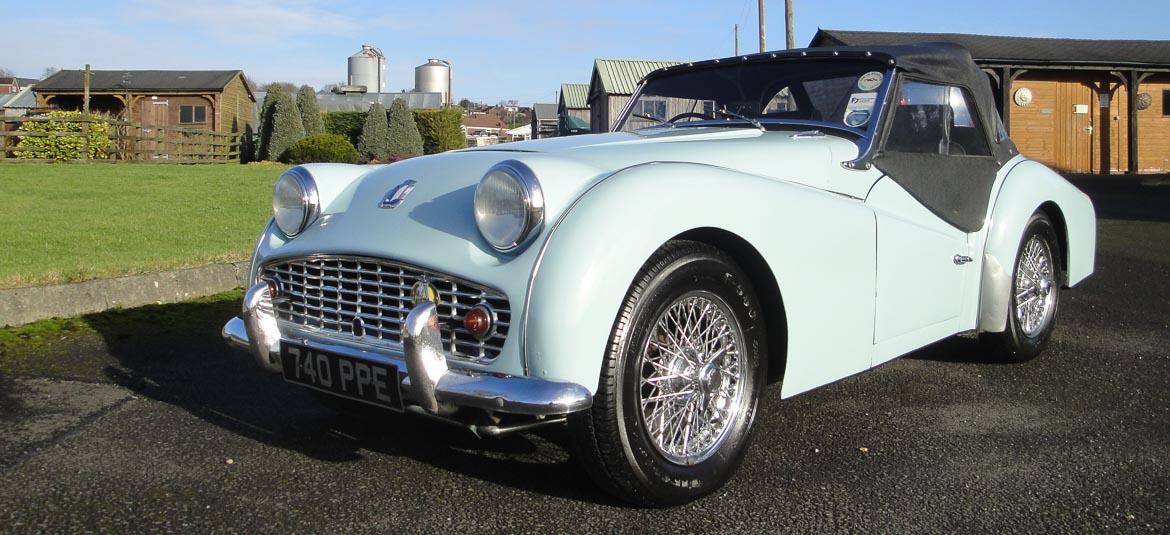
SOLD PRIOR TO AUCTION

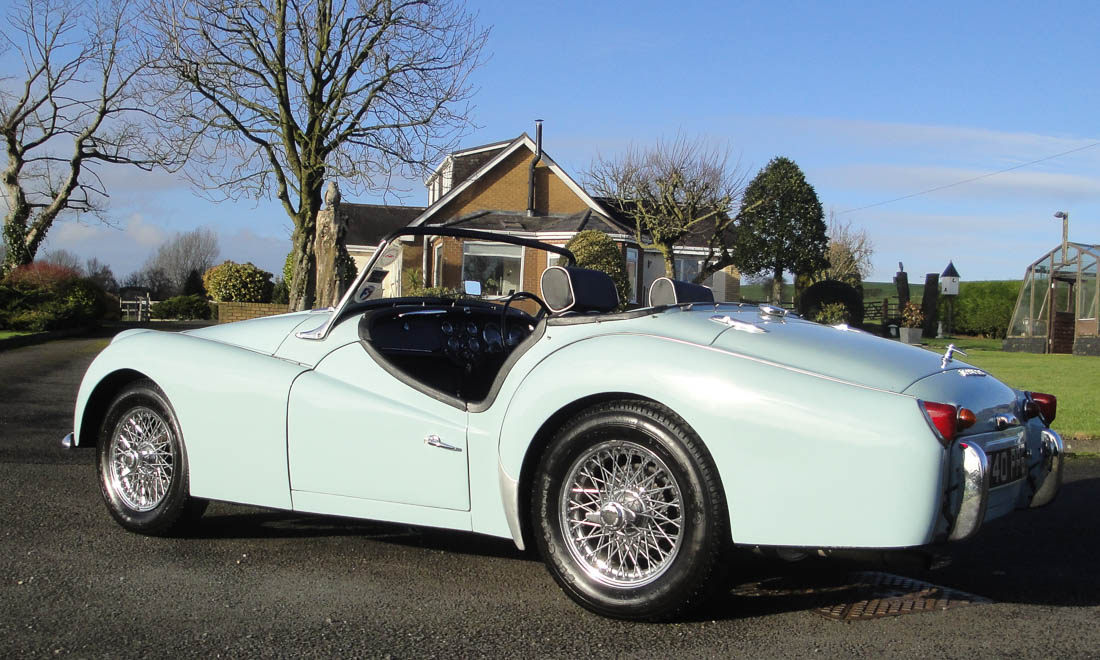
“A real dual-purpose sports car that can work all week and win in competition on weekends.” Sports Illustrated, August 1955.
Into the ‘export at all costs’ post-war sports car market the Standard Motor Company launched the immediately successful Triumph TR2 in 1953 (the “TR1” having been labelled a ‘death trap’ by its development engineer - not perhaps exactly the feedback Management were hoping for), which ultimately spawned the similar looking TR3, Italianate (Michelotti) TR4 and 5 and Germanic (Karmann) influenced TR6 (to avoid distress we won’t go any further along the TR timeline…). Our point is that all the above boasted broadly similar separate chassis underpinnings; twenty-three years with just a few tweaks proves just how good the original TR running gear was.
Well-engineered and with strong performance, the first two iterations of the TR range were perhaps visually a little ‘pre-war’ with bodywork showing the remnants of separate wings. However, with a little imagination, a low light, a squint and perhaps a pint or two of Landlord, it is surely not that dissimilar to a late 1930s BMW 328 (go on, try it, especially the Timmy Taylors bit), right down to the prominent headlights and aluminium stone guards protecting the rear wings and you don’t hear anyone complaining about the Germanic sportster’s looks.
As their quoted Road Test of 1955 ably demonstrated, Sports Illustrated certainly took to the two-seater Triumph, lauding the “sports/racing” car’s performance, versatility, comfort, finish and luggage space, though they were somewhat less flattering about its looks, commenting “When the TR3’s bug-eyed headlamps have been removed and the front slightly redesigned, it will also be a handsome car.” Ouch. They were however particularly impressed that as Triumph’s Competitions Director Ken Richardson pointed out, in a virtually standard machine at 120 MPH on the Mulsanne Straight during that year’s Le Mans 24 Hour race, one could “steer with one hand and light a cigarette with the other” Presumably not one that you had just hand rolled (Tertre Rouge is tricky enough as it is), but you never know - you certainly had options when it came to killing yourself in those days…
Evolving from the TR2 to TR3, the Triumph’s two litre wet liner engine’s output rose at first from 90 to 95 BHP courtesy of larger H6 SU carburettors with a further 5 BHP being added via a high port cylinder head and larger manifolding. Come 1956, ground breaking front discs were swapped in for the original drums, the first time a mass-produced British car had been so equipped, just three years since they had made their competition debut at Le Mans on the Works Jaguar C-Types; these gave the TR3 a significant advantage over its rivals from the likes of MG and Austin Healey.
The TR3A was not conceived as a clean-sheet redesign, but as a thoughtful evolution. Standard-Triumph understood that American buyers, who accounted for the majority of sales, wanted greater comfort and convenience without sacrificing performance. The TR3A therefore, built directly on the proven TR3 platform, addressing usability while leaving the car’s mechanical core largely intact.
Visually, the changes were subtle but important. External door handles facilitated ingress via the cut-away doors, a wider grille improved cooling and revised body detailing gave the car a slightly more polished appearance along with the advantage of a lockable boot. Inside, improved trim, a full-width dashboard and better weather protection made the TR3A more civilised - though never luxurious (good heavens no!). Crucially, the car still looked purposeful. Exposed hinges, upright stance and minimal overhangs gave the TR3A an unmistakably muscular presence, signalling that it remained a sports car first and foremost.







COMMENTS