










“A sporting car for the young and for the young at heart” S. C. H. Davis. Road Test of The Austin-Healey 100. The Autocar.
When Donald and Geoff Healey conceived the first mock-up of the “Healey Hundred” in Donald’s attic, nobody could have predicted the impact the father and son team would have on the sports car market in the years to come. Making a first appearance at the Earls Court Motor Show in 1952, the Healey gained enormous attention and a deal was done on the spot with Sir Leonard Lord of BMC to establish the Austin-Healey marque and get the car into mass production. Healey senior had ambitions to dominate the North American sports car market and this was his first step towards achieving just that.
Like all good business relationships, both parties enjoyed tangible benefits from joining forces; Austin had the pre-formed halo of the Healey name, burnished in international competitions such as the Monte Carlo Rally (which Donald won in 1931) and through the Donald Healey Motor Company Limited’s own range of successful competition machines such as the Silverstone and Westland (then the fastest car ever tested by Motor magazine). From Healey’s perspective, with the stroke of a pen on the contract, he immediately gained access to not only virtually limitless production capacity but development budgets he could only dream of as an independent.
The first fruit of the partnership was the now renamed Austin-Healey 100/4 which utilised the Austin A90’s 2,660 cc, four-cylinder, 90 BHP engine and modified gearbox along with various other suspension and running gear components. Production of the first series, known as the BN1 started in 1953. A few tweaks such as an extra gearbox ratio resulted in the BN2 and the ‘Big Healey’ lineage, which was to endure until 1967, was established.
Austin-Healeys were mechanically robust machines as, despite their unarguably sporting credentials, the oily bits found life relatively easy when tasked with moving a lot less weight around than they were originally designed to. The separate chassis of the larger engined 100/4, 100/6 and 3000 were chunky enough to not only take on the British climate but also responded well to repair should the need arise though, conversely, after a couple of decades their steel and aluminium bodies had often deposited themselves on the floors of MOT testing stations. With the cost of repair far outweighing the cars’ value, the scrapyard was frequently their final destination. A silver lining to that particularly dark cloud was that a whole cottage industry sprang up providing replacement bodies for otherwise viable machines, often in cheap to style and produce fibreglass. Though some of these efforts were best viewed through rose tinted spectacles (or the bottom of a gin glass), one of the best efforts came from Harrietsham based Lenham, already renowned for their top-quality hard tops for upmarket machines such as Jaguar E-Types and Lotus Elans, as well as sleek bodies for Spridgets. They chose to target the strong market for classic, narrow bodied, separate winged machines of the mid to late 1940s and the ‘Lenham Healey’ was very much in the style of a Healey Silverstone or perhaps a Frazer Nash Le Mans Replica - Le Mans Replica replica if you like. Backdated looks (nothing new under the sun Singer, with your long bonnet Porsche 964s) and a significant weight saving (said to be in the region of 250kg) allowed Lenham to give many a tired Healey a new lease of life, ‘LAJ 10’ being a perfect example of this.
On the 9th August 1978, Mr Brian Antill (a motor engineer by trade) made his way to an auction held by Lawrence (Fine Art Auctioneers of Crewkerne) in Maiden Newton where a brace of 100/4s that were being offered as one lot had caught his eye. The bidding spiralled to the heady heights of £190 (a bargain given your correspondent paid £750 for a part finished Frogeye Sprite project just a year later) and both cars were secured with the view of making one good ‘un out of the pair with a useful stash of spares to boot (or should that be two boots?). Unfortunately, on getting them back to his base at Clapton Service Station just outside Crewkerne, Mr Antill found that, once stripped, there was insufficient ‘good’ in the aggregate of both cars to economically restore either to Factory specification. Faced with scrapping not one but two mechanically relatively sound machines, Mr Antill was drawn to the Lenham Motor Company in October 1979 where he and his wife toured the factory, viewed a completed Lenham Healey, had a spot of lunch and duly placed an order for a replacement body and the various associated goodies that go into turning the automotive clock back to the 1940s. Mr Antill informed the Factory that he wanted to carry out as much work as possible himself and that this would be done to the very highest of standards. Correspondence with the Lenham Directors (with whom he became Christmas Card friendly) suggests that with a collection of other Classic Cars (E-Type, MGA, TR3, Austin Healey BJ8 etc.) he was looking for “a car that I can afford to use every day” along with some light competition work in the form of hillclimbs.
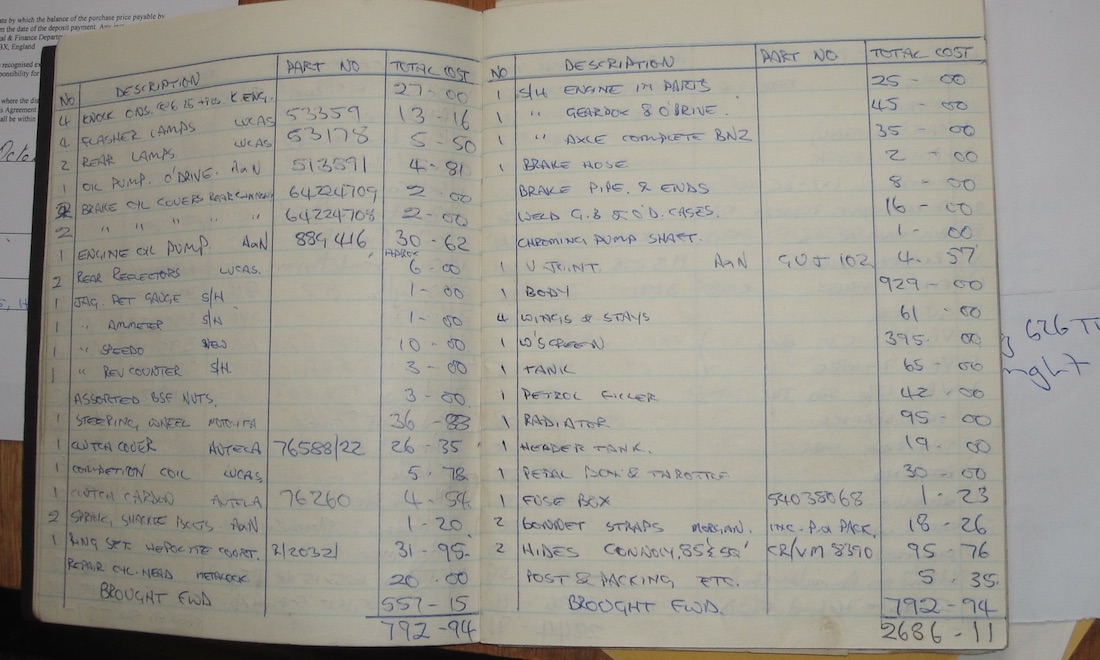
Remarkably, a meticulously kept record of work carried out and money spent on services and components (usefully including part numbers where applicable) is still in the Lenham Healey’s history file. This indicates that work on the Healey running gear and chassis commenced early in January 1980 and was apparently completed just four months later. It is also noted that LAJ 10 was already fitted with the desirable overdrive gearbox, ‘Alfin’ finned alloy brake drums, along with a 100 M distributor and H6 M specification carburettors, though the exact state of tune of the engine was unknown.
Conversion completed, the Healey was registered with the DVLA without drama (a ‘buff logbook’ still in the history file doubtless helped) as an Austin Healey Sports utilising the better of the two donor 100/4’s tallying chassis and registration number, ‘LAJ 10’ being a rather nice bonus.
The Lenham Healey clearly fulfilled its purpose with Mr Antill retaining it for over forty-six years until it was sold, requiring recommissioning, as part of his estate in 2025. This extended ownership period is indicative of just how much he enjoyed the car, (despite the odd frustrations trying to get an Owners’ Club meeting in France off the ground) and when not being driven, it took pride of place in his workshop.
The recommissioning work has now been completed with a new water pump, regulator, fuel pump, brake master cylinder seals and battery fitted. The coolant has been changed, the dynamo checked and the ‘M’ specification carburettors rebuilt.
In our opinion, today the Lenham Healey is in that sweet spot of condition; good enough to park front and centre in the pub carpark, not so good you daren’t take it there in the first place.
The oh so appropriate British Racing Green paintwork is for the most part in very good shape though a machine polish or good old fashioned elbow grease would doubtless add further shine. As shown in the photo gallery, there are a few scratches around bonnet locating recesses and some stone chips on the rear wings but these are very much ‘nature of the beast’ with cycle winged machines and in our opinion, in keeping with the character of the car.
The boat tail body is as good a representation of a pre or just post war Special as you are likely to find without stumping up the considerable funds required for an original example. Its quality is excellent and one struggles to identify which panels are aluminium and which are fibreglass; for the record, those that can be easily seen from both sides, (basically the centre hinged bonnet and engine bay side panels) are made of the former. There is no evidence of cracking or crazing to the fibreglass and the aluminium if free of splits or significant dents. Overall, one would say the condition was good for a fourteen year old body, never mind one that has been on the road for well over forty.
The snug cockpit (literally as it is even fitted with a heater) has been trimmed with Connolly’s finest hide in a shade of green which compliments the paintwork very nicely. The leather extends beyond just the seats to include the edges of the cockpit, side panels and even a neat map pocket in the passenger footwell. Good quality black carpets, a Moto-Lita wood-rim steering wheel, aluminium machine turned dash and built in map light contribute further to what is a delightful environment that has clearly had a lot of time and effort lavished upon it. A full set of Lucas instruments, possibly sourced from a Jaguar, look entirely appropriate with the speedometer, fuel gauge and ammeter biased towards the passenger while the driver is given responsibility for the engine department via a tachometer plus water temp and oil pressure gauges. Unlike its relative/inspiration, the Healey Silverstone, there is a decent amount of luggage space in the Lenham’s tail which can be accessed via a panel behind the seat back released with the T handle supplied. Being hyper-critical (which is our job after all) the stick-on interior mirror is a bit sub-standard, though the upside is it is cracked so it needs to be replaced anyway! While we are nit picking, the fabric gear lever boot would be so much nicer if it was made in leather but putting our now traditional positive spin on this, it could be classed as a potential ‘easy win’.
The seventy-two spoke wire wheels are painted body colour (it’s what defines a gentleman of taste in our view) offset with chromed spinners. Slightly wider than standard for a 100/4, they still look the part with just a dash of added purpose.
The meticulous approach to the build and maintenance of the Lenham is further illustrated by the tyres fitted; excellent Dunlop SP Sports whose 185/15 profile is perfect for both looks and the ride/handling/grip dynamic.
The Alfin brakes fitted to LAJ 10 when it was configured as a standard 100/4 were obviously retained during its restoration and re-bodying so today its braking performance is well up to scratch, especially when one factors in the considerable weight saving that the Lenham conversion gives.
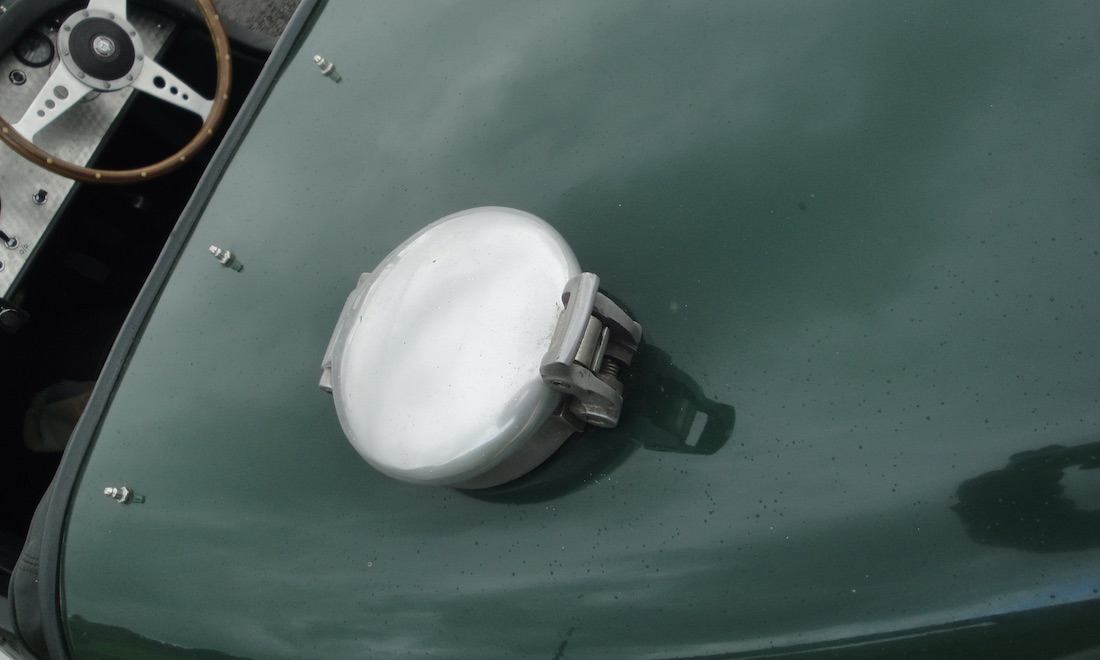
There is not very much brightwork on a Lenham but what there is on LAJ is pretty good. Chromed items such as light bezels, Austin Healey badge, wheel spinners and sidelights have minimal, if any, pitting. The screen surround and rearview mirrors are slightly worse and could do with a polish. Alloy and stainless-steel parts such as the exhaust heat shield, Monza fuel filler cap and radiator grill bars are all good but again you could give them a polish if that’s your thing.
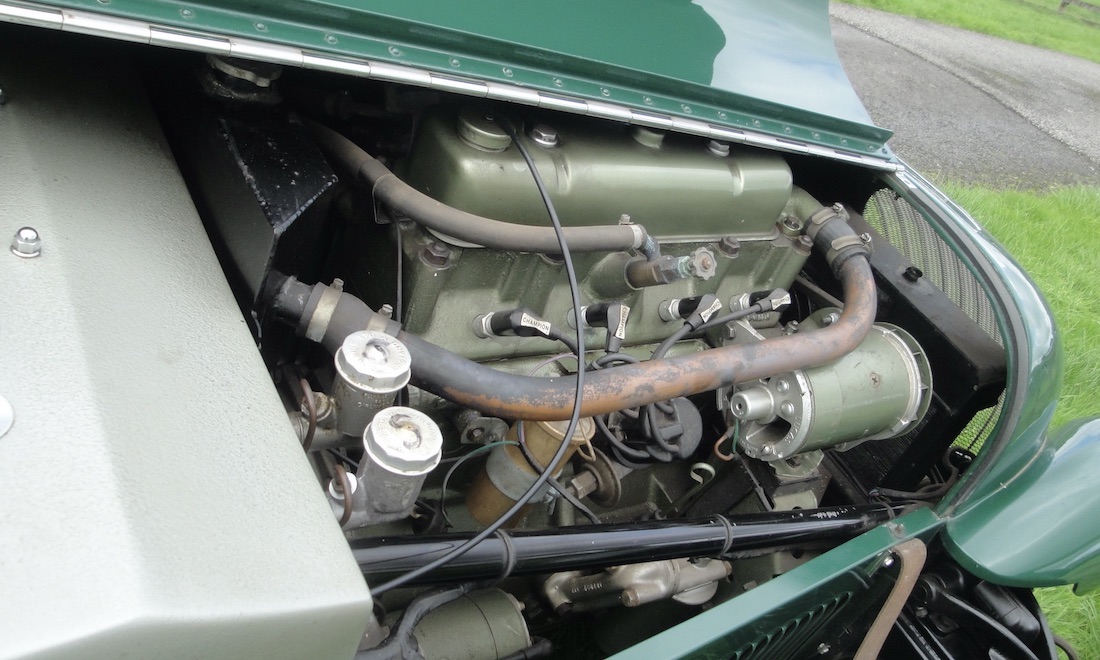
Delving into the functional engine bay all is fluid tight and suitably painted; for example, the correct shade of engine enamel has been used. The new water pump is evident while copper cooling pipes reinforce that pre-war feel.
Given its body style, the Lenham’s chassis and suspension are more noticeable than on other more mundane machines so it is just as well the impression given is of diligent maintenance. The satin black paint is in good order and there is plenty of evidence of grease application while the various rubber bushes and boots look to be in good condition. The rear axle is easily accessed through the floor of the tail section and though it and the associated leaf springs, lever arm dampers and panhard rod are a little grimey, they are reassuringly dry. The new fuel pump is neatly tucked up under the floor, safely out of harms way.
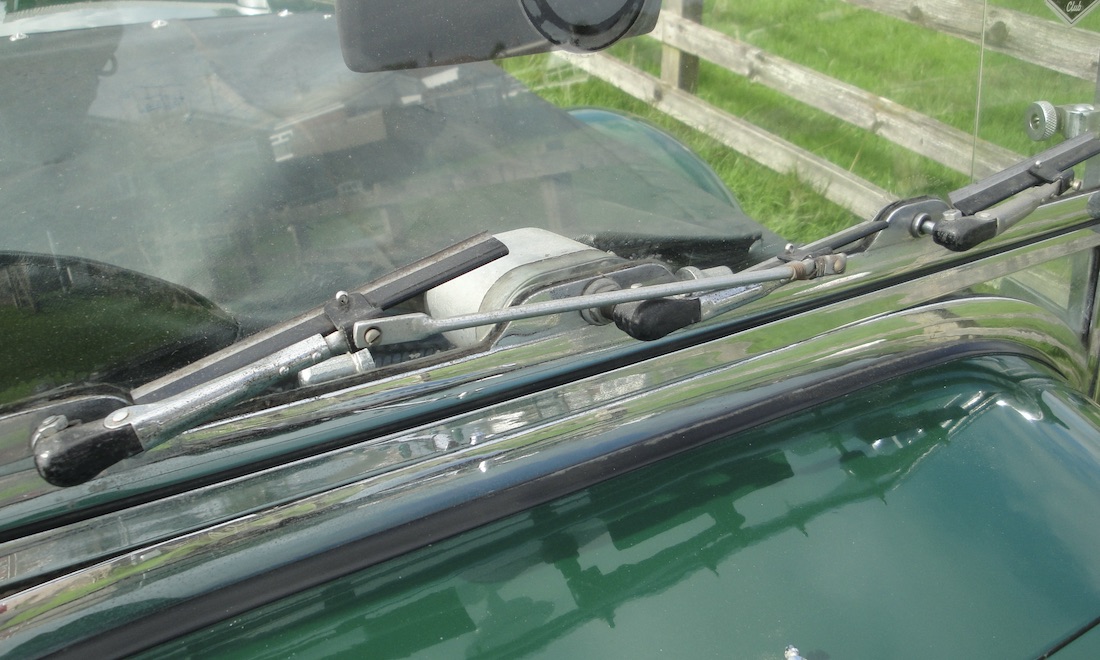
As with all ‘replica’ or ‘homage’ machines, the devil is in the detail and given the background of its original constructor, it is no surprise that the Lenham excels in all areas. Of particular note are the leather bonnet straps, chromed outside handbrake and support bracket, generously sized Monza fuel filler cap, fold flat windscreen with wind deflectors, Union Flag badges, Lucas H4 halogen headlights and extravagant stainless steel twin pipe exhaust, spectacularly upswept with stylish angle cut ends. Less showy but more sensible is the electric cut off switch mounted on the rear bodywork within reach of the driver. Triple wipers, possibly missing part of the linkage, and a well fitted tonneau are about the only nods to inclement weather.
Step over the cut down bodywork, drop into the beautifully aged leather seat and a relaxed driving position is easily found. A slug of choke on an autumnal morning, ignition on, a prod on the starter button and the engine fires up enthusiastically. With no nasty noises and 50 psi showing on the oil pressure gauge, the power unit seems to be in rude health. Add a few revs to pull away and the result is a crackle from the party piece exhaust – it certainly sounds as good as it looks – a soundtrack overlayed with that of the pair of open throated SU carburettors. The benign clutch and bucket loads of torque get you rolling while the sensibly sized steering wheel is the perfect compromise between heft, feel and aesthetics. The Healey runs and drives almost surprisingly well but one might put some of that is down to it looking older than it actually is hence skewing expectations. Having said that, this is clearly a particularly well executed and finessed example.
The plump history file contains the new V5C, an old V5, an early ‘Buff’ logbook and a number of MOT certificates. There is also the aforementioned Christmas Card and various correspondence from the Lenham Motor Company. Interestingly there is also a weighbridge receipt from 1992 which states the Lenham Healey tipped the scales at just 860kg. Bills from the likes of SC Parts are also present along with a quote for an exhaust manifold from renowned experts Derrington which at £165.45 plus VAT, even they admitted was pretty steep! The original leather samples and charming correspondence from Connolly Bros are also present.
We at Berlinetta are card carrying fans of the Big Healey and generally take against ‘pastiches’ of other models so our expectations prior to viewing and testing this Lenham were fairly low. However, the quality of the ‘non-Healey’ components and the care and attention that have been taken with both the assembly and maintenance of this particular example definitely shifted our point of view. Added to this, with the definition of the age at which a car becomes ‘classic’ now hovering around the twenty years mark, something that has lived a life in its current form for well over double that has certainly earned its place on our list of highly desirable machines and the Lenham Healey can be considered a Classic in its own right. The fact that it was owned for the best part of fifty years by the talented enthusiast who built it certainly adds to its allure. Oh, and one last thing, please bear in mind, it could be purchased for a fraction of an Austin-Healey 100/4 on which it is based.







COMMENTS